
.png)
GHOSTS OF THE RECTORY:

THE BENSON FAMILY AND THE HAUNTED HOUSEHOLD
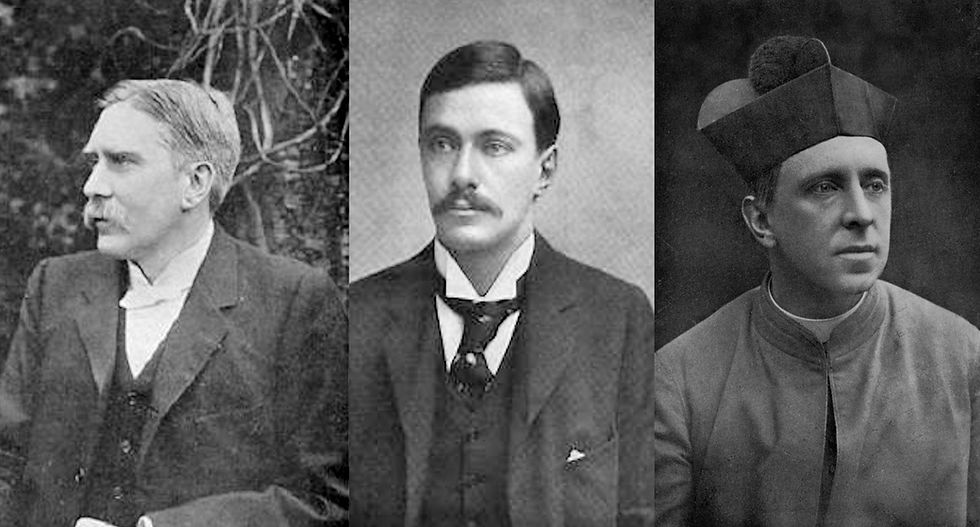
The Bensons were born into shadows—not the theatrical kind cast by candelabra and gaslight, but those dim, persistent shades that gather in religious households where love is fierce, faith is brittle, and grief is never quite allowed to die. Among them, A.C. Benson (Arthur), E.F. Benson (Fred), and R.H. Benson (Robert) form a spectral trinity: haunted, literate, and prolific. They were Monty James’s contemporaries and, in various ways, his emotional kin. Their father was Edward White Benson—eventual Archbishop of Canterbury (himself a lover of ghost stories).
You cannot write about Archbishop E.W. Benson without writing about death. The premature passing of his wife, Mary, and the devastating loss of his talented and humane daughter, Nellie, cast long shadows over the family’s domestic and spiritual lives. Nellie’s death, in particular, struck M.R. James hard. Earlier that same year, he had performed a part in a Benson family play with her. The next he heard, she had contracted diphtheria whilst tending one of her father’s ill servants. Confined to a sealed room, she passed her final days in isolation, writing notes through the window to the family gathered outside. Her last words, scribbled with quiet composure—“I wonder what it will be like. Give them all my love”—are among the most heartbreakingly dignified in the annals of Victorian family tragedy.
The middle brother, E.F. (Fred) Benson, may be best remembered for the Mapp and Lucia novels (written once he took possession of Henry James’ Lamb House in Rye), but he also wrote ghost stories of merit. His tales are more theatrical than Monty’s, less archaeological and more febrile, but they emerge from a similar place: the English house as a site of spiritual rupture. His ghosts are vulgar, clawed, often demonic—but also curiously domestic. They scratch at windows and tiptoe through parlors. The haunted house is never far from the drawing room in an E.F. Benson tale, and some, such as his ‘Caterpillars,’ might be even more unsettling once you move past his literal images of terror and seek for what they mean metaphorically.
The eldest brother, A.C. (Arthur) Benson, too, who famously penned the lyric for the ‘British national anthem,’ ‘Land of Hope and Glory,’ was touched by the uncanny. His diaries, often melancholic, confess a lifelong fascination with death, ritual, and mental illness. James admired him—enough to dedicate a story to him—and shared his understanding of grief as both a personal burden and a communal liturgy. The two had first met as children at school in Temple Grove, forming a friendship that would last the rest of their lives. Arthur was, in all likelihood, James’s oldest and most enduring friend (though not, in point of fact, his best friend). His ghost stories (Basil Netherby, ‘The Grey Cat,’ &c.) are rather dreamlike moral fantasies in which the symbolism of the ghost is more important than the fear. They explore spiritual peril, temptation, pilgrimage, guilt, and redemption revealing unseen consequences of moral choices and often feature a medieval or quasi-medieval setting.
And then there is the youngest brother, R.H. (Robert) Benson, who was perhaps the most spiritually tempestuous of the siblings. He began his clerical life as an Anglican priest but, in 1903, converted to Roman Catholicism and was ordained a Catholic priest the following year (the same year Monty’s first ghost book, Ghost Stories of an Antiquary, appeared). The conversion was a deeply divisive move, one that strained familial expectations and public image alike. Yet Monty James held no animosity and counted R.H. Benson amongst his rarified circle of ghost story writers and close friends. R.H. Benson’s supernatural fiction is less well known today, but its moral clarity and eschatological imagination mark it out. Filtered through a Catholic lens, his stories are concerned less with fright than with judgment—less with the return of the dead than with the reckoning of the soul. In his tales, the invisible world is objectively real, morally charged, and actively engaged in the struggle for human reclamation. His ghosts are less likely to be malevolent while his threats arise from demonic intrusion, spiritual corruption, sin, and the consequences of moral failure. He prefers setting stories in twilit chapels, lonely presbyteries, ancient houses burdened by spiritual history, or ordinary locations suddenly illuminated by the realisation of eternity (which is simultaneously terrifying and consoling).
There is a hauntedness to the Benson family that James recognized, perhaps even envied. They lived amid books and bereavement, in rooms where laughter and scripture mingled uneasily. Their stories, like his, emerge from silence—but their silence is less orderly, more anguished. Where James catalogued the supernatural, the Bensons endured it.
Next month, I will take you along with M.R. James to Cyprus and introduce you to his frog.
Ever, your fellow spirit,
Brian Jay Corrigan


